Australia Commits Billions to Counter-Drone Warfare with Laser and Interceptor Contracts
Initial deals with domestic firms mark a shift toward cheaper, scalable defenses against mass drone threats
Government-led defense policy is driving Australia’s rapid expansion into counter-drone warfare, with Canberra awarding its first contracts under a plan to spend up to A$7 billion on systems designed to defeat unmanned aerial threats.
The Australian government has signed two development contracts worth roughly A$31.7 million with local companies AIM Defence and SYPAQ Systems, marking the first concrete step in a broader दशक-long investment program.
The effort sits within a wider defense strategy that sharply increases spending on drones and countermeasures, reflecting how inexpensive unmanned systems have reshaped modern conflict.
What is confirmed is that the contracts fund two distinct but complementary technologies: a high-energy laser system and an interceptor drone.
AIM Defence will advance its “Fractl” directed-energy weapon, a portable laser capable of tracking small, fast-moving targets and destroying them by burning through structural components.
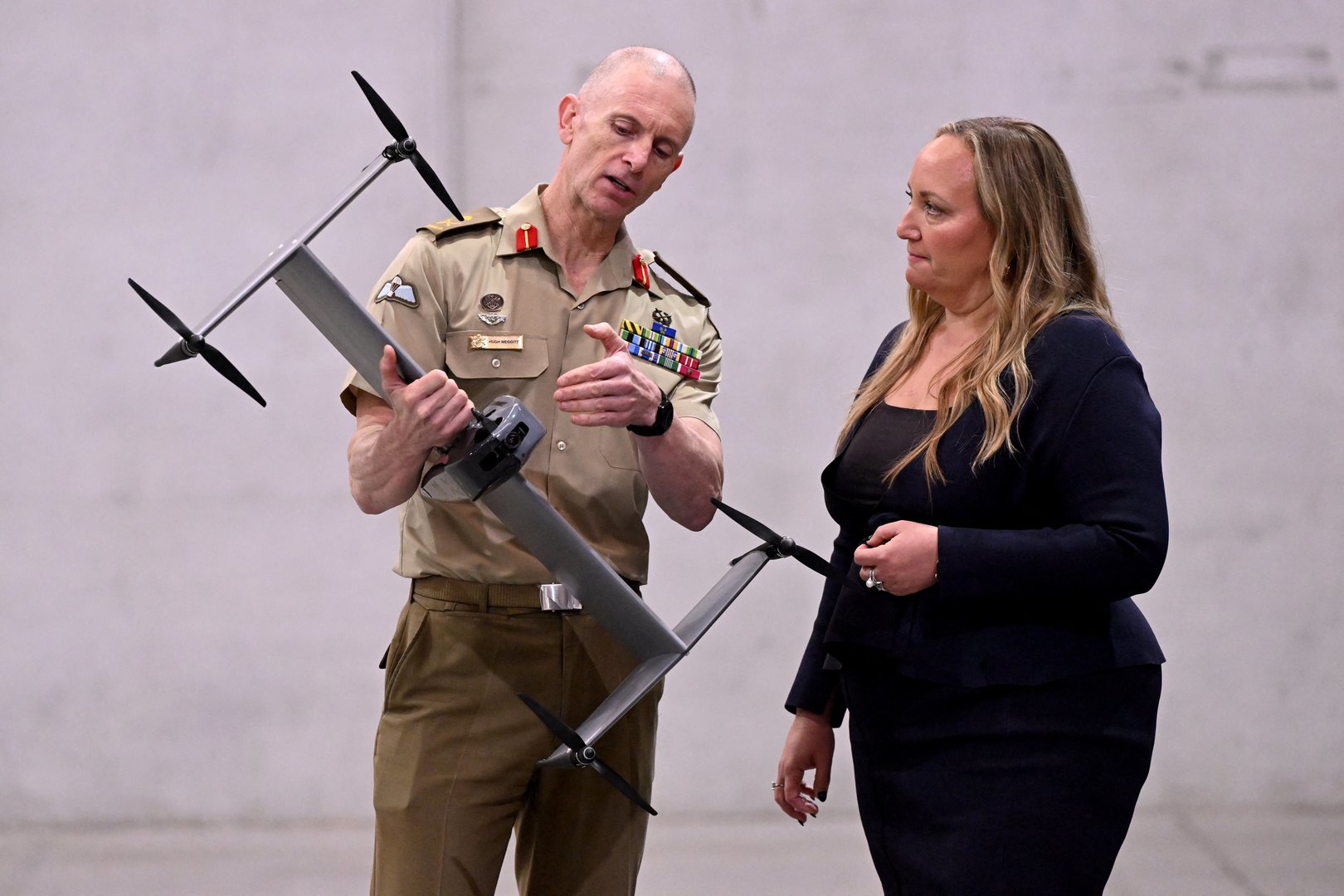
In parallel, SYPAQ Systems will develop the “Corvo Strike,” a small, autonomous interceptor drone designed to track and physically destroy larger hostile drones in flight.
The mechanism behind the investment reflects a core problem now facing militaries: cost asymmetry.
Cheap drones—often costing hundreds or thousands of dollars—can overwhelm traditional air defenses that rely on missiles costing orders of magnitude more.
Australian officials have explicitly framed the new systems as a way to replace or supplement expensive interceptors with lower-cost, scalable alternatives.
Laser weapons, once deployed, offer extremely low per-shot costs, while interceptor drones can be produced and deployed in large numbers.
The operational focus is on two emerging threat categories: medium-sized battlefield drones and swarms of small, low-flying systems.
Both have proven difficult to counter using conventional radar and missile defenses, particularly in conflicts such as Ukraine and in the Middle East, where mass drone attacks have targeted infrastructure and military assets.
The new systems are intended to protect deployed forces overseas as well as critical infrastructure at home.
Technically, the two approaches represent different layers of a future air defense architecture.
Directed-energy weapons like Fractl provide rapid, precise engagement against multiple targets without depleting ammunition, but require sustained power and line-of-sight conditions.
Interceptor drones like Corvo Strike act as mobile, kinetic solutions, capable of chasing and destroying targets beyond the reach or limitations of fixed systems.
Both are expected to integrate into a broader command-and-control network under Australia’s LAND 156 counter-unmanned aerial system program.
The contracts themselves remain developmental rather than operational.
The funded systems are not yet field-ready at scale, and further testing, integration, and procurement decisions will determine whether they become standard equipment within the Australian Defence Force.
The initial funding represents a small fraction of the overall A$7 billion allocation, which also includes upgrades to broader air defense capabilities.
Strategically, the move signals a shift toward sovereign defense manufacturing.
By backing domestic firms, Australia is attempting to build an indigenous industrial base capable of rapidly iterating counter-drone technologies.
This reflects both supply chain concerns and the pace at which drone warfare is evolving, where off-the-shelf innovation and rapid deployment have become decisive advantages.
The implications extend beyond Australia.
Militaries globally are racing to develop layered defenses against drones, combining electronic warfare, kinetic interceptors, and directed-energy weapons.
Australia’s approach—pairing relatively low-cost interceptors with laser systems—mirrors a broader trend toward distributed, scalable defenses designed to handle saturation attacks.
The immediate outcome is clear: Australia has moved from planning to execution in counter-drone defense, with funded prototypes now entering accelerated development under a national program explicitly shaped by lessons from ongoing wars.
The Australian government has signed two development contracts worth roughly A$31.7 million with local companies AIM Defence and SYPAQ Systems, marking the first concrete step in a broader दशक-long investment program.
The effort sits within a wider defense strategy that sharply increases spending on drones and countermeasures, reflecting how inexpensive unmanned systems have reshaped modern conflict.
What is confirmed is that the contracts fund two distinct but complementary technologies: a high-energy laser system and an interceptor drone.
AIM Defence will advance its “Fractl” directed-energy weapon, a portable laser capable of tracking small, fast-moving targets and destroying them by burning through structural components.
In parallel, SYPAQ Systems will develop the “Corvo Strike,” a small, autonomous interceptor drone designed to track and physically destroy larger hostile drones in flight.
The mechanism behind the investment reflects a core problem now facing militaries: cost asymmetry.
Cheap drones—often costing hundreds or thousands of dollars—can overwhelm traditional air defenses that rely on missiles costing orders of magnitude more.
Australian officials have explicitly framed the new systems as a way to replace or supplement expensive interceptors with lower-cost, scalable alternatives.
Laser weapons, once deployed, offer extremely low per-shot costs, while interceptor drones can be produced and deployed in large numbers.
The operational focus is on two emerging threat categories: medium-sized battlefield drones and swarms of small, low-flying systems.
Both have proven difficult to counter using conventional radar and missile defenses, particularly in conflicts such as Ukraine and in the Middle East, where mass drone attacks have targeted infrastructure and military assets.
The new systems are intended to protect deployed forces overseas as well as critical infrastructure at home.
Technically, the two approaches represent different layers of a future air defense architecture.
Directed-energy weapons like Fractl provide rapid, precise engagement against multiple targets without depleting ammunition, but require sustained power and line-of-sight conditions.
Interceptor drones like Corvo Strike act as mobile, kinetic solutions, capable of chasing and destroying targets beyond the reach or limitations of fixed systems.
Both are expected to integrate into a broader command-and-control network under Australia’s LAND 156 counter-unmanned aerial system program.
The contracts themselves remain developmental rather than operational.
The funded systems are not yet field-ready at scale, and further testing, integration, and procurement decisions will determine whether they become standard equipment within the Australian Defence Force.
The initial funding represents a small fraction of the overall A$7 billion allocation, which also includes upgrades to broader air defense capabilities.
Strategically, the move signals a shift toward sovereign defense manufacturing.
By backing domestic firms, Australia is attempting to build an indigenous industrial base capable of rapidly iterating counter-drone technologies.
This reflects both supply chain concerns and the pace at which drone warfare is evolving, where off-the-shelf innovation and rapid deployment have become decisive advantages.
The implications extend beyond Australia.
Militaries globally are racing to develop layered defenses against drones, combining electronic warfare, kinetic interceptors, and directed-energy weapons.
Australia’s approach—pairing relatively low-cost interceptors with laser systems—mirrors a broader trend toward distributed, scalable defenses designed to handle saturation attacks.
The immediate outcome is clear: Australia has moved from planning to execution in counter-drone defense, with funded prototypes now entering accelerated development under a national program explicitly shaped by lessons from ongoing wars.
AI Disclaimer: An advanced artificial intelligence (AI) system generated the content of this page on its own. This innovative technology conducts extensive research from a variety of reliable sources, performs rigorous fact-checking and verification, cleans up and balances biased or manipulated content, and presents a minimal factual summary that is just enough yet essential for you to function as an informed and educated citizen. Please keep in mind, however, that this system is an evolving technology, and as a result, the article may contain accidental inaccuracies or errors. We urge you to help us improve our site by reporting any inaccuracies you find using the "Contact Us" link at the bottom of this page. Your helpful feedback helps us improve our system and deliver more precise content. When you find an article of interest here, please look for the full and extensive coverage of this topic in traditional news sources, as they are written by professional journalists that we try to support, not replace. We appreciate your understanding and assistance.