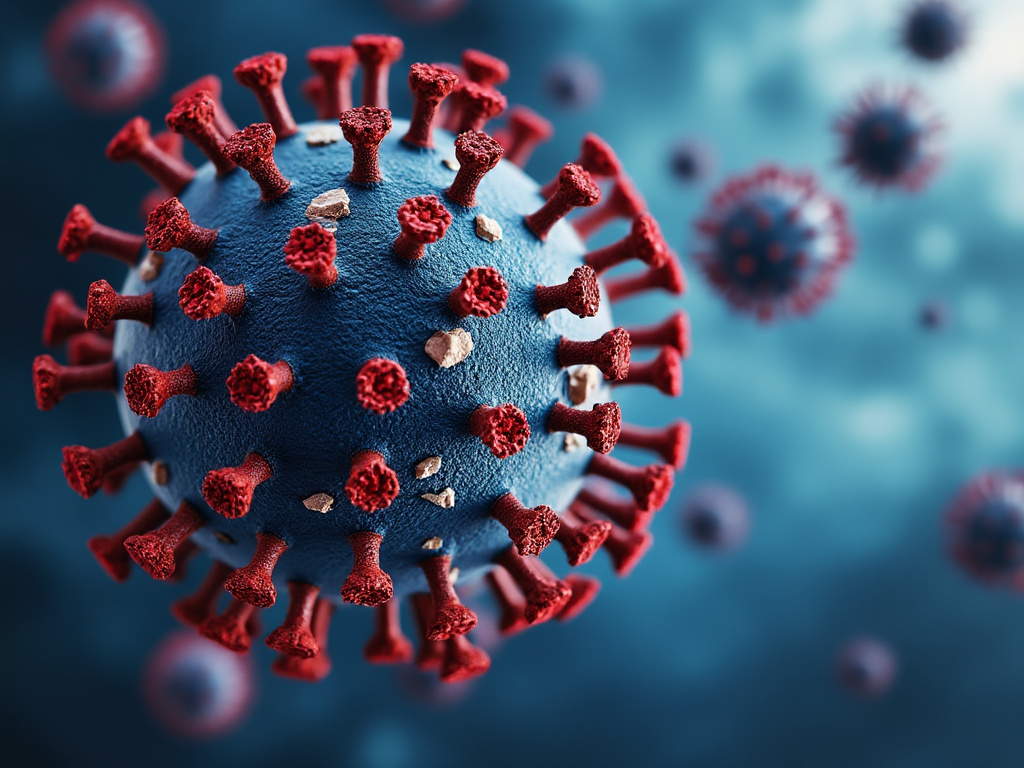
Australia Faces Surge in COVID Infections Amid Emergence of Variant NB.1.8.1
The World Health Organization designates the new variant as a 'variant under monitoring' due to its rapid spread and mutations.
As Australia transitions into colder months, a rise in COVID-19 infections has been attributed to the emergence of a new variant designated NB.1.8.1. Last week, the World Health Organization (WHO) categorized this variant as a 'variant under monitoring' due to its increasing prevalence and distinct characteristics that may differentiate it from previous strains.
Current data indicates that over five years after the COVID-19 pandemic was declared, Australia continues to experience periodic waves of infection.
Accurate tracking of virus occurrences has become increasingly challenging, with fewer individuals engaging in testing and reporting of COVID-19 cases.
However, available statistics indicate an upward trajectory in case numbers as of late May 2025.
Genomic sequencing has confirmed the presence of NB.1.8.1 among circulating strains in Australia, with its prevalence steadily increasing.
Data from sequenced cases up to May 6, 2025, reveal that NB.1.8.1 accounted for less than 10 percent of cases in South Australia, while in Victoria it exceeded 40 percent.
In Western Australia, surveillance of wastewater samples has identified NB.1.8.1 as the dominant strain in collections from Perth.
Globally, NB.1.8.1 is also gaining ground.
By late April 2025, it represented approximately 10.7 percent of all submitted viral sequences, a significant increase from 2.5 percent four weeks earlier.
While the overall number of sequenced cases remains relatively low, this consistent rise sparked enhanced scrutiny from public health authorities worldwide.
Notably, the variant has become dominant in Hong Kong and China as of late April.
The WHO reports that NB.1.8.1 was first identified in samples taken in January 2025 and is classified as a sublineage of the Omicron variant, stemming from a recombinant lineage known as XDV. Recombinant variants arise from the genetic mixing of two or more existing strains.
Mutational analysis of NB.1.8.1 reveals alterations in its spike protein, which is critical for the virus's ability to infect human cells via ACE2 receptors.
Key mutations include T22N, F59S, G184S, A435S, V445H, and T478I.
Although extensive research on the implications of these changes is ongoing, preliminary findings suggest that NB.1.8.1 may bind more effectively to ACE2 receptors than previous variants.
Laboratory model tests indicated that antibodies from vaccinated or previously infected individuals showed reduced effectiveness in neutralizing this variant compared to another recent variant, LP.8.1.1, possibly increasing transmission rates.
Reported symptoms associated with NB.1.8.1 appear to align closely with those of other Omicron subvariants, with common indications including sore throat, fatigue, fever, mild cough, muscle aches, and nasal congestion.
Gastrointestinal symptoms have also been observed in some cases.
Public health officials are focusing on careful monitoring, ongoing genomic sequencing, and encouraging the uptake of updated COVID-19 boosters as the winter respiratory season approaches.
Despite the observed reductions in neutralizing antibody levels against NB.1.8.1, the WHO maintains that current COVID-19 vaccines should continue to offer protection against severe disease caused by this variant.
The most recent boosters available in Australia and other regions target the JN.1 variant, a predecessor of NB.1.8.1, suggesting continued efficacy in preventing serious illness.
Current data indicates that over five years after the COVID-19 pandemic was declared, Australia continues to experience periodic waves of infection.
Accurate tracking of virus occurrences has become increasingly challenging, with fewer individuals engaging in testing and reporting of COVID-19 cases.
However, available statistics indicate an upward trajectory in case numbers as of late May 2025.
Genomic sequencing has confirmed the presence of NB.1.8.1 among circulating strains in Australia, with its prevalence steadily increasing.
Data from sequenced cases up to May 6, 2025, reveal that NB.1.8.1 accounted for less than 10 percent of cases in South Australia, while in Victoria it exceeded 40 percent.
In Western Australia, surveillance of wastewater samples has identified NB.1.8.1 as the dominant strain in collections from Perth.
Globally, NB.1.8.1 is also gaining ground.
By late April 2025, it represented approximately 10.7 percent of all submitted viral sequences, a significant increase from 2.5 percent four weeks earlier.
While the overall number of sequenced cases remains relatively low, this consistent rise sparked enhanced scrutiny from public health authorities worldwide.
Notably, the variant has become dominant in Hong Kong and China as of late April.
The WHO reports that NB.1.8.1 was first identified in samples taken in January 2025 and is classified as a sublineage of the Omicron variant, stemming from a recombinant lineage known as XDV. Recombinant variants arise from the genetic mixing of two or more existing strains.
Mutational analysis of NB.1.8.1 reveals alterations in its spike protein, which is critical for the virus's ability to infect human cells via ACE2 receptors.
Key mutations include T22N, F59S, G184S, A435S, V445H, and T478I.
Although extensive research on the implications of these changes is ongoing, preliminary findings suggest that NB.1.8.1 may bind more effectively to ACE2 receptors than previous variants.
Laboratory model tests indicated that antibodies from vaccinated or previously infected individuals showed reduced effectiveness in neutralizing this variant compared to another recent variant, LP.8.1.1, possibly increasing transmission rates.
Reported symptoms associated with NB.1.8.1 appear to align closely with those of other Omicron subvariants, with common indications including sore throat, fatigue, fever, mild cough, muscle aches, and nasal congestion.
Gastrointestinal symptoms have also been observed in some cases.
Public health officials are focusing on careful monitoring, ongoing genomic sequencing, and encouraging the uptake of updated COVID-19 boosters as the winter respiratory season approaches.
Despite the observed reductions in neutralizing antibody levels against NB.1.8.1, the WHO maintains that current COVID-19 vaccines should continue to offer protection against severe disease caused by this variant.
The most recent boosters available in Australia and other regions target the JN.1 variant, a predecessor of NB.1.8.1, suggesting continued efficacy in preventing serious illness.
AI Disclaimer: An advanced artificial intelligence (AI) system generated the content of this page on its own. This innovative technology conducts extensive research from a variety of reliable sources, performs rigorous fact-checking and verification, cleans up and balances biased or manipulated content, and presents a minimal factual summary that is just enough yet essential for you to function as an informed and educated citizen. Please keep in mind, however, that this system is an evolving technology, and as a result, the article may contain accidental inaccuracies or errors. We urge you to help us improve our site by reporting any inaccuracies you find using the "Contact Us" link at the bottom of this page. Your helpful feedback helps us improve our system and deliver more precise content. When you find an article of interest here, please look for the full and extensive coverage of this topic in traditional news sources, as they are written by professional journalists that we try to support, not replace. We appreciate your understanding and assistance.