
Trump Orders 50% Tariffs on Selected Canadian Imports
Three proclamations covering nearly $20 billion in goods target alleged discrimination against American vehicles, alcohol and dairy, with duties scheduled to begin on August 19.
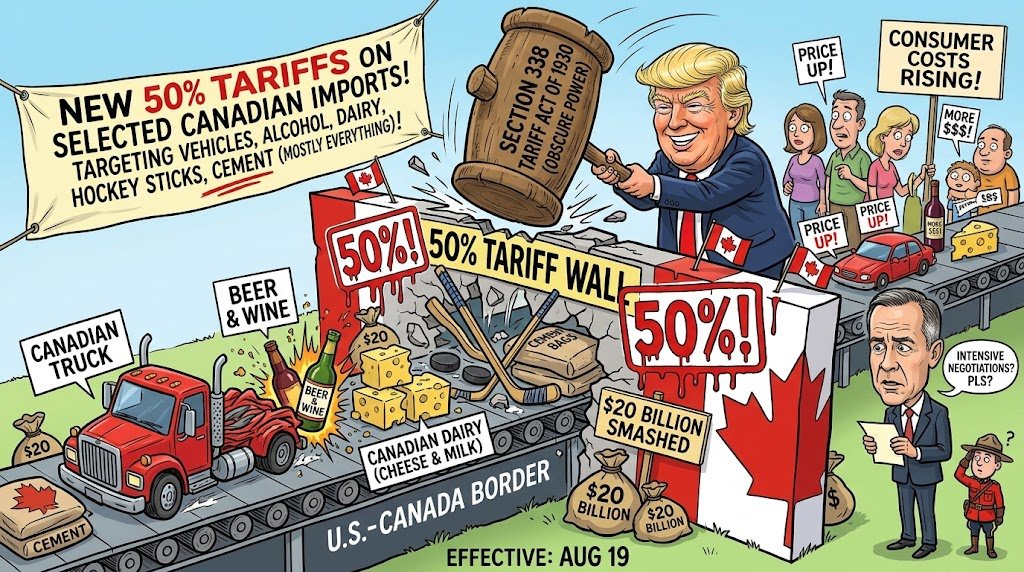
President Donald Trump has ordered additional 50 percent tariffs on nearly $20 billion of selected Canadian imports, sharply escalating a trade dispute over Canada’s treatment of American vehicles, alcoholic beverages and dairy products.
The duties are scheduled to take effect at 12:01 a.m. Eastern time on August 19, leaving 30 days for negotiations before importers become liable for the new charges.
The action consists of three presidential proclamations, each addressing a separate category of alleged discrimination.
Although the dispute centers on vehicles, alcohol and dairy, the retaliatory product lists extend to goods such as wine, hockey equipment and cement.
The measures are broad, but they do not cover every Canadian export to the United States.
Energy, potash, fish, critical minerals and several other categories are excluded.
Products already governed by national-security tariffs under Section 232, including steel, aluminum, copper, automobiles and certain auto parts, are also outside the new measures.
Those exemptions protect commodities and industrial inputs for which American buyers depend heavily on Canadian supply, while leaving existing sectoral duties intact.
Goods listed in the three proclamations will be taxed even when they satisfy the rules of origin under the United States-Mexico-Canada Agreement.
That is a consequential departure from earlier tariff measures, which generally allowed qualifying Canadian products to retain preferential access under the continental trade pact.
The new duties are additional to other applicable customs charges.
Trump invoked Section 338 of the Tariff Act of 1930, an obscure provision authorizing the president to impose duties of up to 50 percent when another country places the commerce of the United States at a disadvantage.
The statute has rarely been used and differs from the emergency-powers law underpinning the administration’s earlier global tariffs, which the Supreme Court rejected in February.
Section 338 gives the president explicit tariff authority, but its application can still face judicial examination.
A legal challenge could test whether Canada’s measures satisfy the statute’s standard of discrimination, whether the selected American response properly offsets the alleged disadvantage and how the duties interact with commitments under the continental trade agreement.
Washington says Canada grants unequal treatment to American exporters.
Its case begins with provincial restrictions on United States alcoholic beverages introduced during the earlier tariff confrontation.
Most Canadian provinces and territories stopped purchasing, distributing or selling American alcohol, while continuing to handle products from other countries.
American alcohol exports to Canada subsequently fell by about 81 percent, a decline of approximately $582 million over the comparable annual period.
The administration also objects to Canadian tariffs and quotas affecting vehicles imported from the United States.
It says the system treats vehicles from some other countries more favorably and pressures American manufacturers to maintain production in Canada.
Canadian imports of United States motor vehicles declined by roughly 22 percent, or $5.6 billion, between April 2025 and March 2026 compared with the preceding year.
Dairy is the third dispute.
Canada manages imports through tariff-rate quotas, allowing designated quantities to enter at lower duty rates before steep charges apply.
Washington argues that access for American cheese is more restrictive than the treatment Canada gives comparable European products.
Canada maintains that its dairy system and trade measures comply with its rights and obligations.
Ottawa presents the confrontation differently.
Prime Minister Mark Carney said Canada’s remaining countermeasures were adopted in response to earlier United States tariffs, including restrictions that his government considers violations of the North American trade agreement.
He warned that the latest duties would raise costs for American households but stopped short of announcing immediate retaliation.
Carney instead offered intensive negotiations during the 30-day period.
Ontario Premier Doug Ford and other Canadian political figures have urged Ottawa to prepare a stronger response if the tariffs proceed.
Canadian countermeasures could concentrate on politically sensitive American exports, although the federal government has not confirmed a new retaliatory list.
The dispute arrives during the formal review of the United States-Mexico-Canada Agreement.
Washington declined to extend the agreement in its current form during the initial review, triggering further negotiations rather than immediately terminating the pact.
The tariff decision adds pressure to those talks by demonstrating that products meeting the agreement’s origin rules may still face separate duties imposed under domestic law.
Canada and the United States maintain one of the world’s largest bilateral commercial relationships, with goods trade valued at approximately $716 billion in 2025. Their manufacturing systems are deeply integrated: components frequently cross the border several times before a finished product reaches consumers.
A 50 percent duty can therefore affect Canadian producers, American importers and downstream businesses simultaneously.
Importers legally pay tariffs at the United States border.
They may absorb the expense, demand lower prices from Canadian suppliers, change sourcing arrangements or pass part of the charge to customers.
The eventual distribution of the cost will differ by industry, depending on margins, available substitutes and the ease with which supply chains can be reorganized.
The administration says the measures are intended to obtain reciprocal treatment for American exports rather than sever bilateral commerce.
Canada describes them as another unilateral escalation and maintains that its own restrictions were defensive.
The immediate path is now fixed: negotiators have until August 19 to resolve the three disputes before the additional 50 percent duties begin.
The duties are scheduled to take effect at 12:01 a.m. Eastern time on August 19, leaving 30 days for negotiations before importers become liable for the new charges.
The action consists of three presidential proclamations, each addressing a separate category of alleged discrimination.
Although the dispute centers on vehicles, alcohol and dairy, the retaliatory product lists extend to goods such as wine, hockey equipment and cement.
The measures are broad, but they do not cover every Canadian export to the United States.
Energy, potash, fish, critical minerals and several other categories are excluded.
Products already governed by national-security tariffs under Section 232, including steel, aluminum, copper, automobiles and certain auto parts, are also outside the new measures.
Those exemptions protect commodities and industrial inputs for which American buyers depend heavily on Canadian supply, while leaving existing sectoral duties intact.
Goods listed in the three proclamations will be taxed even when they satisfy the rules of origin under the United States-Mexico-Canada Agreement.
That is a consequential departure from earlier tariff measures, which generally allowed qualifying Canadian products to retain preferential access under the continental trade pact.
The new duties are additional to other applicable customs charges.
Trump invoked Section 338 of the Tariff Act of 1930, an obscure provision authorizing the president to impose duties of up to 50 percent when another country places the commerce of the United States at a disadvantage.
The statute has rarely been used and differs from the emergency-powers law underpinning the administration’s earlier global tariffs, which the Supreme Court rejected in February.
Section 338 gives the president explicit tariff authority, but its application can still face judicial examination.
A legal challenge could test whether Canada’s measures satisfy the statute’s standard of discrimination, whether the selected American response properly offsets the alleged disadvantage and how the duties interact with commitments under the continental trade agreement.
Washington says Canada grants unequal treatment to American exporters.
Its case begins with provincial restrictions on United States alcoholic beverages introduced during the earlier tariff confrontation.
Most Canadian provinces and territories stopped purchasing, distributing or selling American alcohol, while continuing to handle products from other countries.
American alcohol exports to Canada subsequently fell by about 81 percent, a decline of approximately $582 million over the comparable annual period.
The administration also objects to Canadian tariffs and quotas affecting vehicles imported from the United States.
It says the system treats vehicles from some other countries more favorably and pressures American manufacturers to maintain production in Canada.
Canadian imports of United States motor vehicles declined by roughly 22 percent, or $5.6 billion, between April 2025 and March 2026 compared with the preceding year.
Dairy is the third dispute.
Canada manages imports through tariff-rate quotas, allowing designated quantities to enter at lower duty rates before steep charges apply.
Washington argues that access for American cheese is more restrictive than the treatment Canada gives comparable European products.
Canada maintains that its dairy system and trade measures comply with its rights and obligations.
Ottawa presents the confrontation differently.
Prime Minister Mark Carney said Canada’s remaining countermeasures were adopted in response to earlier United States tariffs, including restrictions that his government considers violations of the North American trade agreement.
He warned that the latest duties would raise costs for American households but stopped short of announcing immediate retaliation.
Carney instead offered intensive negotiations during the 30-day period.
Ontario Premier Doug Ford and other Canadian political figures have urged Ottawa to prepare a stronger response if the tariffs proceed.
Canadian countermeasures could concentrate on politically sensitive American exports, although the federal government has not confirmed a new retaliatory list.
The dispute arrives during the formal review of the United States-Mexico-Canada Agreement.
Washington declined to extend the agreement in its current form during the initial review, triggering further negotiations rather than immediately terminating the pact.
The tariff decision adds pressure to those talks by demonstrating that products meeting the agreement’s origin rules may still face separate duties imposed under domestic law.
Canada and the United States maintain one of the world’s largest bilateral commercial relationships, with goods trade valued at approximately $716 billion in 2025. Their manufacturing systems are deeply integrated: components frequently cross the border several times before a finished product reaches consumers.
A 50 percent duty can therefore affect Canadian producers, American importers and downstream businesses simultaneously.
Importers legally pay tariffs at the United States border.
They may absorb the expense, demand lower prices from Canadian suppliers, change sourcing arrangements or pass part of the charge to customers.
The eventual distribution of the cost will differ by industry, depending on margins, available substitutes and the ease with which supply chains can be reorganized.
The administration says the measures are intended to obtain reciprocal treatment for American exports rather than sever bilateral commerce.
Canada describes them as another unilateral escalation and maintains that its own restrictions were defensive.
The immediate path is now fixed: negotiators have until August 19 to resolve the three disputes before the additional 50 percent duties begin.
AI Disclaimer: An advanced artificial intelligence (AI) system generated the content of this page on its own. This innovative technology conducts extensive research from a variety of reliable sources, performs rigorous fact-checking and verification, cleans up and balances biased or manipulated content, and presents a minimal factual summary that is just enough yet essential for you to function as an informed and educated citizen. Please keep in mind, however, that this system is an evolving technology, and as a result, the article may contain accidental inaccuracies or errors. We urge you to help us improve our site by reporting any inaccuracies you find using the "Contact Us" link at the bottom of this page. Your helpful feedback helps us improve our system and deliver more precise content. When you find an article of interest here, please look for the full and extensive coverage of this topic in traditional news sources, as they are written by professional journalists that we try to support, not replace. We appreciate your understanding and assistance.