
Australia Returns to the America’s Cup After a Quarter-Century Absence
A new Australian syndicate backed by elite sailors, private capital and advanced foiling technology will compete in the 2027 America’s Cup in Naples, marking the country’s first challenge since 2000.
The America’s Cup, sailing’s oldest and most technologically demanding competition, is getting an Australian challenger again after more than twenty-five years without a national entry.
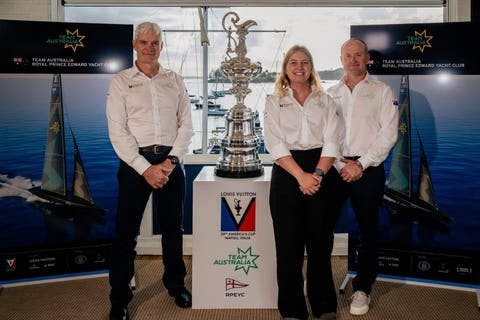
Team Australia formally confirmed this week that it will compete in the 38th America’s Cup in Naples in 2027, ending a long absence that many in the sport considered increasingly difficult to justify for one of sailing’s most historically significant countries.
The story is fundamentally actor-driven.
Without a new syndicate led by businessman John Winning Jr, Olympic champion Tom Slingsby and veteran America’s Cup executive Grant Simmer, Australia would still be absent from the event.
Their campaign combines private funding, elite Australian sailing talent spread across international teams, and a commercial structure that supporters believe finally makes participation financially sustainable.
What is confirmed is that the Royal Prince Edward Yacht Club in Sydney has submitted and secured acceptance of its official challenge.
Team Australia will compete in the AC75 foiling monohull class, the same category that has transformed the modern America’s Cup into a high-speed engineering contest where boats effectively fly above the water on hydrofoils.
The return matters far beyond sport.
Australia occupies a unique place in America’s Cup history because Australia II ended the New York Yacht Club’s 132-year winning streak in 1983, one of the defining moments in international sailing.
That victory reshaped the competition from an elite American-controlled contest into a truly global event.
Since then, however, Australian participation has been inconsistent and financially unstable.
The country’s last challenge came in 2000 through the Young Australia syndicate.
The new campaign is attempting to solve the central problem that has kept Australia out of the event for decades: cost.
Modern America’s Cup campaigns operate at the intersection of aerospace engineering, naval architecture, advanced composites and data-driven simulation.
Even with formal budget limits now in place, a competitive challenge requires tens of millions of dollars, specialist design teams and long-term institutional backing.
Grant Simmer, who was part of the original Australia II campaign and later became one of the most influential executives in the modern Cup era, is leading the syndicate as chief executive.
Tom Slingsby, Australia’s best-known modern sailor and a multiple SailGP champion, will oversee sailing operations.
Glenn Ashby, another highly decorated Australian sailor with multiple America’s Cup victories under New Zealand campaigns, will direct performance and design.
That combination reveals a broader reality about modern elite sailing: Australia never stopped producing world-class talent.
Instead, Australian sailors increasingly worked for foreign syndicates because Australia lacked the financial and institutional structure to field its own competitive team.
The new campaign is effectively attempting to repatriate that expertise.
The team has already secured a critical technical shortcut by acquiring “Te Rehutai,” the AC75 yacht used by Emirates Team New Zealand during its successful 2021 campaign.
The boat is undergoing modifications in New Zealand ahead of testing and development for Naples.
That decision is financially and strategically important because building an entirely new AC75 platform from scratch would substantially increase costs and development risk.
Modern America’s Cup competition is no longer purely about physical sailing skill.
The AC75 class demands advanced flight control, computational simulation, aerodynamic optimization and real-time data processing more commonly associated with Formula One engineering.
Team Australia has confirmed it will rely heavily on simulation systems in Sydney before extensive on-water testing begins.
The competition itself is also changing structurally.
Organizers have introduced governance reforms intended to reduce the stop-start instability that historically plagued the event.
Teams now participate in a more integrated commercial structure with greater continuity between Cup cycles.
Supporters of the Australian challenge argue that this shift finally provides a pathway for long-term participation rather than one-off billionaire-backed campaigns.
Another confirmed change is the mandatory inclusion of female sailors in race crews for the first time in the event’s history.
Australian sailor Tash Bryant has already been announced as part of the syndicate.
The rule change reflects broader pressure on elite sailing to widen participation in a sport historically dominated by male crews and private wealth.
The return also arrives during a transitional period for professional sailing.
SailGP, the fast-growing international foiling league co-founded by Oracle billionaire Larry Ellison and champion sailor Russell Coutts, has altered the economics and visibility of elite sailing.
Many of the athletes now leading Team Australia built their reputations in SailGP’s commercially streamlined format rather than through traditional America’s Cup pathways.
That overlap matters because the America’s Cup is increasingly competing for relevance inside its own sport.
While supporters view the AC75 boats as the pinnacle of sailing technology, critics argue the competition has drifted away from traditional match racing and become overly dependent on engineering budgets and proprietary technology.
Online sailing communities remain sharply divided over whether hydrofoiling monohulls have improved or diluted the event.
The political symbolism of Australia’s return is also significant for the wider competition.
New Zealand remains the defending champion and has become the dominant force of the modern era, winning multiple consecutive Cups while attracting international talent, including Australians.
The new Australian challenge reintroduces one of sailing’s oldest rivalries at a time when organizers are trying to strengthen global interest before the Naples regatta.
Naples itself reflects the competition’s broader strategic shift toward commercially attractive host cities capable of underwriting large-scale waterfront sporting events.
The Cup is now as much a tourism, infrastructure and global branding exercise as it is a sailing competition.
For Australia, the stakes extend beyond whether the team can realistically win in 2027. The syndicate is openly framing the campaign as a long-term rebuild of Australia’s America’s Cup infrastructure, with ambitions to develop future sailors, engineers and designers rather than disappear after one cycle.
That objective may ultimately matter more than immediate results.
Australia’s return restores one of the sport’s foundational nations to its premier event and signals that the America’s Cup’s modern commercial model may finally be capable of sustaining broader international participation beyond a handful of entrenched super-teams.
AI Disclaimer: An advanced artificial intelligence (AI) system generated the content of this page on its own. This innovative technology conducts extensive research from a variety of reliable sources, performs rigorous fact-checking and verification, cleans up and balances biased or manipulated content, and presents a minimal factual summary that is just enough yet essential for you to function as an informed and educated citizen. Please keep in mind, however, that this system is an evolving technology, and as a result, the article may contain accidental inaccuracies or errors. We urge you to help us improve our site by reporting any inaccuracies you find using the "Contact Us" link at the bottom of this page. Your helpful feedback helps us improve our system and deliver more precise content. When you find an article of interest here, please look for the full and extensive coverage of this topic in traditional news sources, as they are written by professional journalists that we try to support, not replace. We appreciate your understanding and assistance.