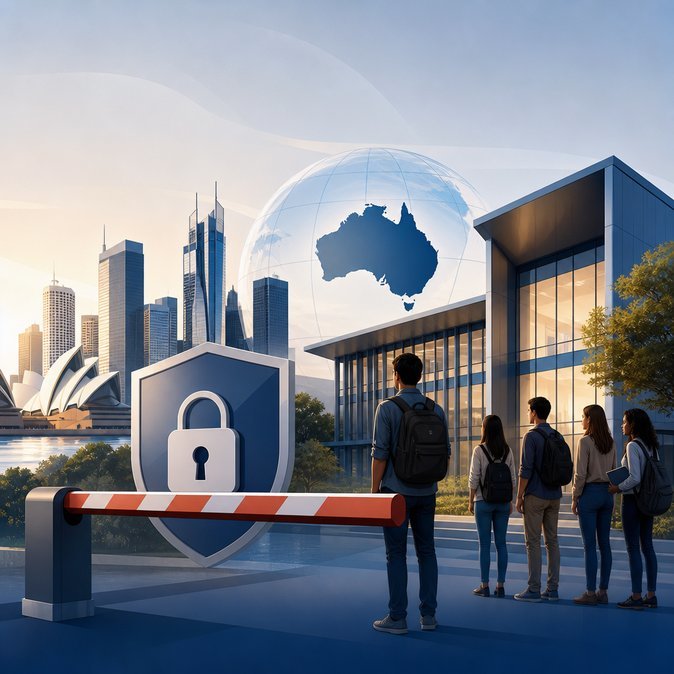
Australia Freezes New Private College Enrolments for International Students in Major Policy Reset
Twelve-month pause targets private education providers amid concerns over system strain, student exploitation risks, and migration-linked demand pressures
SYSTEM-DRIVEN immigration and education policy in Australia has triggered a one-year freeze on new international student enrolments at selected private colleges, marking a significant intervention in how the country manages one of its largest export industries.
What is confirmed is that the Australian government has introduced a 12-month suspension on new international student commencements at a range of private vocational and higher education providers.
The measure does not apply uniformly across all institutions, but is focused on parts of the private education sector that authorities consider higher risk in terms of compliance, quality assurance, and migration-linked enrolment practices.
The policy is part of a broader tightening of international education rules, as Australia seeks to balance its reliance on international students as a major economic contributor with growing political and social pressure over migration levels, housing affordability, and system integrity.
International education remains one of Australia’s largest service exports, with hundreds of thousands of students enrolled each year across universities, private colleges, and vocational institutions.
Officials have framed the suspension as a corrective measure aimed at reducing system abuse, including concerns that some providers may be using student visas primarily as a pathway to long-term residency rather than delivering consistent educational outcomes.
The government’s approach also reflects concern that rapid growth in certain private institutions has outpaced regulatory oversight capacity.
The freeze effectively blocks new offshore and onshore student commencements into affected providers for the duration of the 12-month period.
Existing students are not removed from their courses, but the restriction limits the pipeline of new enrolments, creating immediate financial pressure for institutions that rely heavily on international student fees.
Private colleges are expected to be the most exposed segment of the sector.
Unlike large public universities, many private providers depend on continuous intake cycles and have less diversified revenue streams.
Industry groups have warned that prolonged restrictions could lead to course closures, staffing reductions, and consolidation across the sector, particularly among smaller operators.
The policy also intersects with Australia’s broader migration framework.
International students often transition into temporary graduate visas after completing their studies, and some eventually move toward permanent residency pathways.
This has made the student visa system a politically sensitive component of migration management, especially during periods of high net migration.
Supporters of the freeze argue it is necessary to restore integrity and ensure that education providers meet minimum standards before expanding further international intake.
They also point to cases where students have reportedly been enrolled in low-quality courses with limited academic or employment value, raising concerns about exploitation and reputational damage to Australia’s education export brand.
Critics, including parts of the education industry, warn that broad restrictions risk damaging Australia’s global competitiveness as a destination for international students.
They argue that uncertainty in visa and enrolment policy may push students toward competing destinations in North America, Europe, and parts of Asia, where regulatory frameworks are perceived as more stable.
The government has indicated that the freeze is temporary and intended to allow time for regulatory recalibration, including improved oversight of provider quality and enrolment practices.
The longer-term direction of policy is expected to focus on tighter accreditation standards, stronger monitoring of recruitment agents, and more direct control over sector growth.
The immediate consequence is a sudden contraction in new international student flows into affected private institutions, setting up a structural adjustment across parts of Australia’s education export industry and reinforcing the government’s shift toward tighter migration-linked education controls.
What is confirmed is that the Australian government has introduced a 12-month suspension on new international student commencements at a range of private vocational and higher education providers.
The measure does not apply uniformly across all institutions, but is focused on parts of the private education sector that authorities consider higher risk in terms of compliance, quality assurance, and migration-linked enrolment practices.
The policy is part of a broader tightening of international education rules, as Australia seeks to balance its reliance on international students as a major economic contributor with growing political and social pressure over migration levels, housing affordability, and system integrity.
International education remains one of Australia’s largest service exports, with hundreds of thousands of students enrolled each year across universities, private colleges, and vocational institutions.
Officials have framed the suspension as a corrective measure aimed at reducing system abuse, including concerns that some providers may be using student visas primarily as a pathway to long-term residency rather than delivering consistent educational outcomes.
The government’s approach also reflects concern that rapid growth in certain private institutions has outpaced regulatory oversight capacity.
The freeze effectively blocks new offshore and onshore student commencements into affected providers for the duration of the 12-month period.
Existing students are not removed from their courses, but the restriction limits the pipeline of new enrolments, creating immediate financial pressure for institutions that rely heavily on international student fees.
Private colleges are expected to be the most exposed segment of the sector.
Unlike large public universities, many private providers depend on continuous intake cycles and have less diversified revenue streams.
Industry groups have warned that prolonged restrictions could lead to course closures, staffing reductions, and consolidation across the sector, particularly among smaller operators.
The policy also intersects with Australia’s broader migration framework.
International students often transition into temporary graduate visas after completing their studies, and some eventually move toward permanent residency pathways.
This has made the student visa system a politically sensitive component of migration management, especially during periods of high net migration.
Supporters of the freeze argue it is necessary to restore integrity and ensure that education providers meet minimum standards before expanding further international intake.
They also point to cases where students have reportedly been enrolled in low-quality courses with limited academic or employment value, raising concerns about exploitation and reputational damage to Australia’s education export brand.
Critics, including parts of the education industry, warn that broad restrictions risk damaging Australia’s global competitiveness as a destination for international students.
They argue that uncertainty in visa and enrolment policy may push students toward competing destinations in North America, Europe, and parts of Asia, where regulatory frameworks are perceived as more stable.
The government has indicated that the freeze is temporary and intended to allow time for regulatory recalibration, including improved oversight of provider quality and enrolment practices.
The longer-term direction of policy is expected to focus on tighter accreditation standards, stronger monitoring of recruitment agents, and more direct control over sector growth.
The immediate consequence is a sudden contraction in new international student flows into affected private institutions, setting up a structural adjustment across parts of Australia’s education export industry and reinforcing the government’s shift toward tighter migration-linked education controls.
AI Disclaimer: An advanced artificial intelligence (AI) system generated the content of this page on its own. This innovative technology conducts extensive research from a variety of reliable sources, performs rigorous fact-checking and verification, cleans up and balances biased or manipulated content, and presents a minimal factual summary that is just enough yet essential for you to function as an informed and educated citizen. Please keep in mind, however, that this system is an evolving technology, and as a result, the article may contain accidental inaccuracies or errors. We urge you to help us improve our site by reporting any inaccuracies you find using the "Contact Us" link at the bottom of this page. Your helpful feedback helps us improve our system and deliver more precise content. When you find an article of interest here, please look for the full and extensive coverage of this topic in traditional news sources, as they are written by professional journalists that we try to support, not replace. We appreciate your understanding and assistance.