Trump’s Hardline Immigration Drive Draws Parallels with Australia’s Past Border Policies
The Biden-era immigration backlash in the United States under Donald Trump echoes elements of Australia’s historical approach to asylum seekers and migrant control, prompting debate at home and abroad
President Donald Trump’s intensified crackdown on migrants in the United States has reignited global discussion about how hardline border strategies resemble elements of Australia’s past and contemporary immigration practices.
Trump’s second presidency has seen a dramatic expansion of immigration enforcement, including mass deportations, interior raids and paused legal immigration case processing that have cumulatively reshaped national policy on migrants and asylum seekers.
Under Trump, the administration set a historically low refugee admissions cap for the United States, suspended immigrant visa processing for nationals of dozens of countries in early 2026 and overseen the deportation of hundreds of thousands of people, contributing to a net negative immigration flow for the first time in decades.
These moves have drawn comparisons to Australia’s long-standing hardline stance on irregular arrivals and offshore processing — policies intended to deter unauthorised migration by imposing strict controls on asylum seekers and irregular entrants without a clear right to stay.
Australia’s own history of mandatory detention and offshore centres has been referenced in international analyses as a model that influenced global debates on border security, with key parallels in hostile environments for some migrant groups and a focus on deterrence rather than integration.
Critics and human rights advocates argue that such approaches prioritise deterrence over humane treatment and erode protections for vulnerable populations.
The current United States-Australia connection has also attracted scrutiny through corporate links: a U.S. company with contracts to manage Australian immigration detention centres has played a role in Trump’s enforcement apparatus as well, raising ethical questions about the commercialisation of migrant detention.
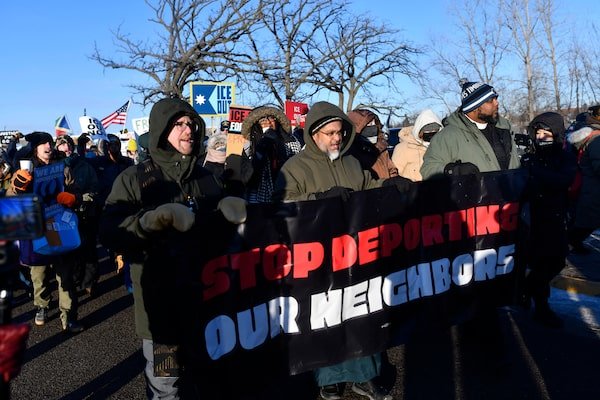
The unfolding U.S. policy environment has triggered both domestic and international reactions, including resistance from municipal leaders concerned about public safety and legal challenges to expansive federal powers.
The comparison with Australia’s past offers a lens through which to evaluate how entrenched immigration control strategies can migrate across jurisdictions, even as policymakers and advocates differ sharply on the balance between sovereignty, security and humanitarian obligations.
Trump’s second presidency has seen a dramatic expansion of immigration enforcement, including mass deportations, interior raids and paused legal immigration case processing that have cumulatively reshaped national policy on migrants and asylum seekers.
Under Trump, the administration set a historically low refugee admissions cap for the United States, suspended immigrant visa processing for nationals of dozens of countries in early 2026 and overseen the deportation of hundreds of thousands of people, contributing to a net negative immigration flow for the first time in decades.
These moves have drawn comparisons to Australia’s long-standing hardline stance on irregular arrivals and offshore processing — policies intended to deter unauthorised migration by imposing strict controls on asylum seekers and irregular entrants without a clear right to stay.
Australia’s own history of mandatory detention and offshore centres has been referenced in international analyses as a model that influenced global debates on border security, with key parallels in hostile environments for some migrant groups and a focus on deterrence rather than integration.
Critics and human rights advocates argue that such approaches prioritise deterrence over humane treatment and erode protections for vulnerable populations.
The current United States-Australia connection has also attracted scrutiny through corporate links: a U.S. company with contracts to manage Australian immigration detention centres has played a role in Trump’s enforcement apparatus as well, raising ethical questions about the commercialisation of migrant detention.
The unfolding U.S. policy environment has triggered both domestic and international reactions, including resistance from municipal leaders concerned about public safety and legal challenges to expansive federal powers.
The comparison with Australia’s past offers a lens through which to evaluate how entrenched immigration control strategies can migrate across jurisdictions, even as policymakers and advocates differ sharply on the balance between sovereignty, security and humanitarian obligations.
AI Disclaimer: An advanced artificial intelligence (AI) system generated the content of this page on its own. This innovative technology conducts extensive research from a variety of reliable sources, performs rigorous fact-checking and verification, cleans up and balances biased or manipulated content, and presents a minimal factual summary that is just enough yet essential for you to function as an informed and educated citizen. Please keep in mind, however, that this system is an evolving technology, and as a result, the article may contain accidental inaccuracies or errors. We urge you to help us improve our site by reporting any inaccuracies you find using the "Contact Us" link at the bottom of this page. Your helpful feedback helps us improve our system and deliver more precise content. When you find an article of interest here, please look for the full and extensive coverage of this topic in traditional news sources, as they are written by professional journalists that we try to support, not replace. We appreciate your understanding and assistance.