Australia and Japan Deepen Military Integration as Indo-Pacific Tensions Reshape Regional Security
New defence agreements between Canberra and Tokyo expand intelligence sharing, weapons cooperation and joint military operations, marking a major shift in Japan’s postwar security posture.
Australia and Japan have formally expanded their defence partnership into a far deeper military relationship, with both governments describing each other as sources of growing “strategic depth” in an increasingly volatile Indo-Pacific security environment.
The story is system-driven.
The agreements are not isolated diplomatic gestures or symbolic defence announcements.
They are part of a long-term restructuring of regional security architecture driven by China’s military expansion, instability in maritime trade routes, pressure on critical supply chains and growing concern that the United States alone may no longer be sufficient as the sole security anchor in Asia.
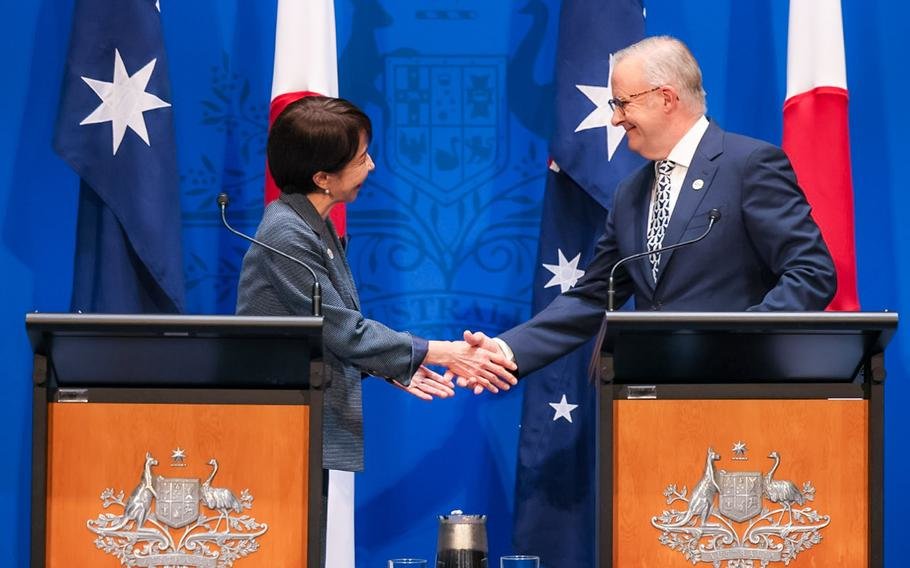
What is confirmed is that Australian Prime Minister Anthony Albanese and Japanese Prime Minister Sanae Takaichi signed a new Joint Statement on Enhanced Defence and Security Cooperation in Canberra this week.
The agreement builds directly on earlier defence frameworks signed in 2022, 2023 and 2025, but significantly expands operational integration between the two countries.
The most consequential phrase in the agreement states that Australia and Japan are becoming increasingly important to each other’s “strategic depth.” In military terms, strategic depth refers to the ability of a state to extend operational resilience, supply chains, force mobility and defence infrastructure beyond its immediate territory.
The language signals that both governments increasingly view their security as interconnected rather than merely cooperative.
The agreements include expanded intelligence sharing, joint weapons testing, co-development of military technologies, integrated logistics support, cyber cooperation, advanced training exercises and closer defence industrial coordination.
Officials also confirmed plans for greater interoperability between the Australian Defence Force and Japan Self-Defense Forces.
This marks a historic shift for Japan.
For decades after World War Two, Japan maintained highly constrained military policies under its pacifist constitution and relied heavily on the United States security umbrella.
Although Tokyo has steadily expanded defence capabilities over the past fifteen years, the latest agreements demonstrate Japan’s transition toward a more active regional military role with trusted partners beyond Washington.
Australia has emerged as Japan’s most strategically aligned security partner in the Indo-Pacific outside the United States.
That alignment is being reinforced through concrete military procurement.
Last month, Australia finalized contracts for Japanese-designed Mogami-class frigates under the SEA 3000 naval modernization program.
The deal represents one of Japan’s largest defence exports since Tokyo relaxed longstanding restrictions on overseas military sales.
The frigate agreement is strategically important beyond shipbuilding alone.
It creates long-term industrial integration between Japanese and Australian defence sectors, including maintenance, sustainment and technology-sharing arrangements expected to last decades.
Defence officials in both countries have framed the program as foundational to future military interoperability.
The security relationship is also broadening beyond conventional defence.
Australia and Japan announced a separate cyber partnership aimed at coordinating responses to evolving cyber threats and protecting critical infrastructure.
Governments increasingly view cyber defence, supply-chain resilience and military readiness as interconnected national-security functions rather than separate policy areas.
Energy security has become another major driver of the partnership.
The latest agreements were signed amid heightened global concern over instability affecting maritime trade routes and fuel supplies.
Japan depends heavily on imported energy, while Australia is one of Japan’s largest suppliers of liquefied natural gas and critical minerals.
Both governments now openly describe economic resilience as part of national defence strategy.
Their new agreements include commitments to secure critical maritime traffic, stabilize energy flows and reduce dependence on concentrated supply chains vulnerable to geopolitical coercion.
China is the central strategic factor shaping the partnership, even when not named directly in official language.
Canberra and Tokyo increasingly share concerns over Chinese military activity in the East China Sea, South China Sea and around Taiwan.
They are also aligned on fears that economic coercion, cyber pressure and maritime expansion could destabilize the broader Indo-Pacific balance.
Neither government is openly presenting the partnership as an anti-China alliance.
Both Australia and Japan remain economically connected to China and continue to emphasize diplomatic engagement.
But the military direction is unmistakable: both countries are building stronger collective deterrence capabilities alongside the United States and other regional partners.
The agreements also reflect broader uncertainty about global security guarantees.
Across the Indo-Pacific, governments are responding to fears that future American administrations could reduce overseas commitments or demand greater burden-sharing from allies.
Strengthening middle-power defence partnerships is increasingly viewed as insurance against strategic unpredictability.
The pace of military normalization inside Japan is especially significant.
Defence spending has risen sharply under recent Japanese governments, and Tokyo is now investing heavily in missile systems, naval expansion, cyber capability and defence exports.
The political debate inside Japan has shifted from whether the country should expand military power to how quickly and extensively it should do so.
Australia has embraced that shift more openly than many regional partners.
Canberra increasingly sees Japan not just as a diplomatic ally but as a core pillar of Indo-Pacific deterrence strategy.
Joint exercises, intelligence integration and defence industry cooperation are moving from occasional collaboration toward semi-permanent institutional alignment.
The strategic implications extend beyond the bilateral relationship.
Other regional powers, including India, the Philippines and several Southeast Asian states, are strengthening ties with Japan amid rising concern over maritime security and strategic competition in Asia.
Japan’s expanding defence role is gradually reshaping the region’s security network.
The agreements also carry domestic political significance.
In Australia, bipartisan support for closer ties with Japan remains strong despite wider political divisions.
In Japan, the partnership helps normalize a larger international defence role without formally revising the country’s pacifist constitution.
The immediate consequence is that Australia and Japan are no longer operating as loosely aligned partners coordinating around occasional regional concerns.
They are building a far more integrated security framework designed to sustain military readiness, industrial resilience and strategic deterrence across the Indo-Pacific for the long term.
The story is system-driven.
The agreements are not isolated diplomatic gestures or symbolic defence announcements.
They are part of a long-term restructuring of regional security architecture driven by China’s military expansion, instability in maritime trade routes, pressure on critical supply chains and growing concern that the United States alone may no longer be sufficient as the sole security anchor in Asia.
What is confirmed is that Australian Prime Minister Anthony Albanese and Japanese Prime Minister Sanae Takaichi signed a new Joint Statement on Enhanced Defence and Security Cooperation in Canberra this week.
The agreement builds directly on earlier defence frameworks signed in 2022, 2023 and 2025, but significantly expands operational integration between the two countries.
The most consequential phrase in the agreement states that Australia and Japan are becoming increasingly important to each other’s “strategic depth.” In military terms, strategic depth refers to the ability of a state to extend operational resilience, supply chains, force mobility and defence infrastructure beyond its immediate territory.
The language signals that both governments increasingly view their security as interconnected rather than merely cooperative.
The agreements include expanded intelligence sharing, joint weapons testing, co-development of military technologies, integrated logistics support, cyber cooperation, advanced training exercises and closer defence industrial coordination.
Officials also confirmed plans for greater interoperability between the Australian Defence Force and Japan Self-Defense Forces.
This marks a historic shift for Japan.
For decades after World War Two, Japan maintained highly constrained military policies under its pacifist constitution and relied heavily on the United States security umbrella.
Although Tokyo has steadily expanded defence capabilities over the past fifteen years, the latest agreements demonstrate Japan’s transition toward a more active regional military role with trusted partners beyond Washington.
Australia has emerged as Japan’s most strategically aligned security partner in the Indo-Pacific outside the United States.
That alignment is being reinforced through concrete military procurement.
Last month, Australia finalized contracts for Japanese-designed Mogami-class frigates under the SEA 3000 naval modernization program.
The deal represents one of Japan’s largest defence exports since Tokyo relaxed longstanding restrictions on overseas military sales.
The frigate agreement is strategically important beyond shipbuilding alone.
It creates long-term industrial integration between Japanese and Australian defence sectors, including maintenance, sustainment and technology-sharing arrangements expected to last decades.
Defence officials in both countries have framed the program as foundational to future military interoperability.
The security relationship is also broadening beyond conventional defence.
Australia and Japan announced a separate cyber partnership aimed at coordinating responses to evolving cyber threats and protecting critical infrastructure.
Governments increasingly view cyber defence, supply-chain resilience and military readiness as interconnected national-security functions rather than separate policy areas.
Energy security has become another major driver of the partnership.
The latest agreements were signed amid heightened global concern over instability affecting maritime trade routes and fuel supplies.
Japan depends heavily on imported energy, while Australia is one of Japan’s largest suppliers of liquefied natural gas and critical minerals.
Both governments now openly describe economic resilience as part of national defence strategy.
Their new agreements include commitments to secure critical maritime traffic, stabilize energy flows and reduce dependence on concentrated supply chains vulnerable to geopolitical coercion.
China is the central strategic factor shaping the partnership, even when not named directly in official language.
Canberra and Tokyo increasingly share concerns over Chinese military activity in the East China Sea, South China Sea and around Taiwan.
They are also aligned on fears that economic coercion, cyber pressure and maritime expansion could destabilize the broader Indo-Pacific balance.
Neither government is openly presenting the partnership as an anti-China alliance.
Both Australia and Japan remain economically connected to China and continue to emphasize diplomatic engagement.
But the military direction is unmistakable: both countries are building stronger collective deterrence capabilities alongside the United States and other regional partners.
The agreements also reflect broader uncertainty about global security guarantees.
Across the Indo-Pacific, governments are responding to fears that future American administrations could reduce overseas commitments or demand greater burden-sharing from allies.
Strengthening middle-power defence partnerships is increasingly viewed as insurance against strategic unpredictability.
The pace of military normalization inside Japan is especially significant.
Defence spending has risen sharply under recent Japanese governments, and Tokyo is now investing heavily in missile systems, naval expansion, cyber capability and defence exports.
The political debate inside Japan has shifted from whether the country should expand military power to how quickly and extensively it should do so.
Australia has embraced that shift more openly than many regional partners.
Canberra increasingly sees Japan not just as a diplomatic ally but as a core pillar of Indo-Pacific deterrence strategy.
Joint exercises, intelligence integration and defence industry cooperation are moving from occasional collaboration toward semi-permanent institutional alignment.
The strategic implications extend beyond the bilateral relationship.
Other regional powers, including India, the Philippines and several Southeast Asian states, are strengthening ties with Japan amid rising concern over maritime security and strategic competition in Asia.
Japan’s expanding defence role is gradually reshaping the region’s security network.
The agreements also carry domestic political significance.
In Australia, bipartisan support for closer ties with Japan remains strong despite wider political divisions.
In Japan, the partnership helps normalize a larger international defence role without formally revising the country’s pacifist constitution.
The immediate consequence is that Australia and Japan are no longer operating as loosely aligned partners coordinating around occasional regional concerns.
They are building a far more integrated security framework designed to sustain military readiness, industrial resilience and strategic deterrence across the Indo-Pacific for the long term.
AI Disclaimer: An advanced artificial intelligence (AI) system generated the content of this page on its own. This innovative technology conducts extensive research from a variety of reliable sources, performs rigorous fact-checking and verification, cleans up and balances biased or manipulated content, and presents a minimal factual summary that is just enough yet essential for you to function as an informed and educated citizen. Please keep in mind, however, that this system is an evolving technology, and as a result, the article may contain accidental inaccuracies or errors. We urge you to help us improve our site by reporting any inaccuracies you find using the "Contact Us" link at the bottom of this page. Your helpful feedback helps us improve our system and deliver more precise content. When you find an article of interest here, please look for the full and extensive coverage of this topic in traditional news sources, as they are written by professional journalists that we try to support, not replace. We appreciate your understanding and assistance.