
Australia Launches Multi-Billion-Dollar Collins-Class Submarine Overhaul to Avoid Capability Gap
Canberra begins a major life-extension program for its aging submarine fleet as delays, industrial strain, and regional military competition intensify pressure on the AUKUS transition
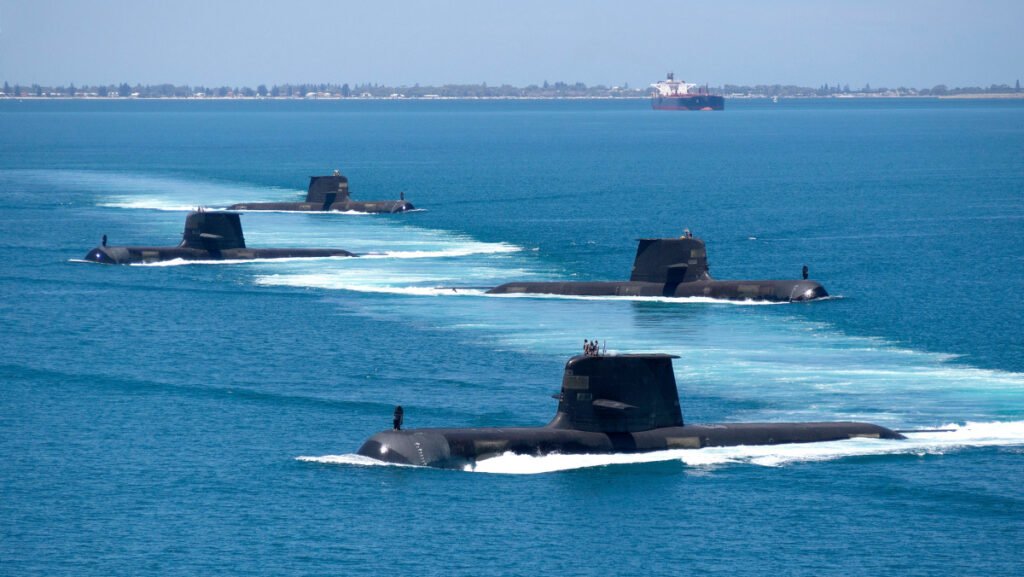
Australia’s defense procurement system is entering a critical transition phase as the government formally begins a life-extension program for its Collins-class submarines, committing an estimated A$12 billion, or roughly US$7.8 billion, to keep the aging fleet operational well into the 2030s.
The project is not primarily about modernization.
Its core purpose is to prevent a major underwater capability gap before Australia receives future nuclear-powered submarines under the AUKUS security partnership with the United States and the United Kingdom.
Without extending the operational life of the six Collins-class boats, Australia risks losing a substantial portion of its submarine deterrent capacity before replacement vessels become available.
The Collins-class submarines entered service between the mid-1990s and early 2000s and were originally expected to retire earlier than the current timeline now envisioned by defense planners.
The boats require extensive structural work, propulsion upgrades, combat-system maintenance, and deep engineering overhauls to remain operational for another decade or more.
What is confirmed is that the first full life-of-type extension work has begun on HMAS Farncomb at the Osborne naval shipyard in South Australia.
The process is expected to take years per submarine and involves dismantling major sections of the vessel to replace aging systems, modernize components, and restore long-term operational reliability.
The strategic driver behind the program is the long delivery horizon attached to AUKUS.
Australia is not expected to receive its first nuclear-powered submarines for many years.
Current planning involves acquiring Virginia-class submarines from the United States before eventually building a new class of AUKUS submarines with British design support.
That schedule remains politically and industrially complex.
The Collins extension program therefore acts as a bridge between Australia’s current conventional submarine force and its future nuclear fleet.
Defense officials view continuous submarine capability as essential given rapidly intensifying naval competition across the Indo-Pacific, especially amid China’s military expansion and growing contest over maritime access routes.
The practical challenge is industrial capacity.
Australia is attempting to maintain and modernize its existing submarines while simultaneously preparing an entirely new nuclear submarine enterprise requiring specialized infrastructure, nuclear stewardship systems, workforce expansion, and advanced engineering capabilities.
This creates overlapping strains on shipyards, defense contractors, and skilled labor pipelines.
Analysts and former naval officials have repeatedly warned that workforce shortages and industrial bottlenecks could become one of the biggest risks to the entire AUKUS transition.
Cost escalation is another major factor.
The Collins-class extension budget has expanded substantially from earlier estimates as inflation, supply-chain disruptions, technical complexity, and labor costs increase across global defense industries.
Long submarine maintenance cycles also reduce fleet availability, meaning fewer boats may be operational at any given time during the overhaul period.
The capability risk is significant because Australia already operates a relatively small submarine fleet.
Any prolonged maintenance delays can sharply reduce operational readiness and strategic flexibility in surrounding waters.
The program also carries political implications.
The Albanese government has framed the extension effort as evidence that Australia is building a sovereign defense industrial base capable of supporting advanced naval systems domestically.
South Australia, where much of the work is centered, has become a focal point for long-term defense manufacturing investment and workforce development.
Critics, however, argue that Australia is now paying heavily for years of procurement instability and changing submarine strategies.
The previous cancellation of the French-designed Attack-class submarine project left Australia dependent on an extended transition timeline whose success relies heavily on future American production capacity and bipartisan political support in Washington.
There is also broader regional significance.
Australia’s submarine buildup forms part of a larger strategic realignment among Indo-Pacific allies responding to rising geopolitical competition.
Nuclear-powered submarines would give Australia longer operational reach, greater endurance, and enhanced integration with US and British naval operations.
For now, however, the country’s near-term underwater deterrent still depends on the aging Collins fleet.
The life-extension program is therefore less a stopgap than a strategic necessity designed to preserve Australia’s military continuity during one of the most ambitious and expensive defense transitions in its modern history.
The next major milestone will be the completion of the first extended Collins-class overhaul before additional submarines enter the same multi-year refurbishment cycle, locking the fleet into Australia’s defense posture through at least the next decade.
The project is not primarily about modernization.
Its core purpose is to prevent a major underwater capability gap before Australia receives future nuclear-powered submarines under the AUKUS security partnership with the United States and the United Kingdom.
Without extending the operational life of the six Collins-class boats, Australia risks losing a substantial portion of its submarine deterrent capacity before replacement vessels become available.
The Collins-class submarines entered service between the mid-1990s and early 2000s and were originally expected to retire earlier than the current timeline now envisioned by defense planners.
The boats require extensive structural work, propulsion upgrades, combat-system maintenance, and deep engineering overhauls to remain operational for another decade or more.
What is confirmed is that the first full life-of-type extension work has begun on HMAS Farncomb at the Osborne naval shipyard in South Australia.
The process is expected to take years per submarine and involves dismantling major sections of the vessel to replace aging systems, modernize components, and restore long-term operational reliability.
The strategic driver behind the program is the long delivery horizon attached to AUKUS.
Australia is not expected to receive its first nuclear-powered submarines for many years.
Current planning involves acquiring Virginia-class submarines from the United States before eventually building a new class of AUKUS submarines with British design support.
That schedule remains politically and industrially complex.
The Collins extension program therefore acts as a bridge between Australia’s current conventional submarine force and its future nuclear fleet.
Defense officials view continuous submarine capability as essential given rapidly intensifying naval competition across the Indo-Pacific, especially amid China’s military expansion and growing contest over maritime access routes.
The practical challenge is industrial capacity.
Australia is attempting to maintain and modernize its existing submarines while simultaneously preparing an entirely new nuclear submarine enterprise requiring specialized infrastructure, nuclear stewardship systems, workforce expansion, and advanced engineering capabilities.
This creates overlapping strains on shipyards, defense contractors, and skilled labor pipelines.
Analysts and former naval officials have repeatedly warned that workforce shortages and industrial bottlenecks could become one of the biggest risks to the entire AUKUS transition.
Cost escalation is another major factor.
The Collins-class extension budget has expanded substantially from earlier estimates as inflation, supply-chain disruptions, technical complexity, and labor costs increase across global defense industries.
Long submarine maintenance cycles also reduce fleet availability, meaning fewer boats may be operational at any given time during the overhaul period.
The capability risk is significant because Australia already operates a relatively small submarine fleet.
Any prolonged maintenance delays can sharply reduce operational readiness and strategic flexibility in surrounding waters.
The program also carries political implications.
The Albanese government has framed the extension effort as evidence that Australia is building a sovereign defense industrial base capable of supporting advanced naval systems domestically.
South Australia, where much of the work is centered, has become a focal point for long-term defense manufacturing investment and workforce development.
Critics, however, argue that Australia is now paying heavily for years of procurement instability and changing submarine strategies.
The previous cancellation of the French-designed Attack-class submarine project left Australia dependent on an extended transition timeline whose success relies heavily on future American production capacity and bipartisan political support in Washington.
There is also broader regional significance.
Australia’s submarine buildup forms part of a larger strategic realignment among Indo-Pacific allies responding to rising geopolitical competition.
Nuclear-powered submarines would give Australia longer operational reach, greater endurance, and enhanced integration with US and British naval operations.
For now, however, the country’s near-term underwater deterrent still depends on the aging Collins fleet.
The life-extension program is therefore less a stopgap than a strategic necessity designed to preserve Australia’s military continuity during one of the most ambitious and expensive defense transitions in its modern history.
The next major milestone will be the completion of the first extended Collins-class overhaul before additional submarines enter the same multi-year refurbishment cycle, locking the fleet into Australia’s defense posture through at least the next decade.
AI Disclaimer: An advanced artificial intelligence (AI) system generated the content of this page on its own. This innovative technology conducts extensive research from a variety of reliable sources, performs rigorous fact-checking and verification, cleans up and balances biased or manipulated content, and presents a minimal factual summary that is just enough yet essential for you to function as an informed and educated citizen. Please keep in mind, however, that this system is an evolving technology, and as a result, the article may contain accidental inaccuracies or errors. We urge you to help us improve our site by reporting any inaccuracies you find using the "Contact Us" link at the bottom of this page. Your helpful feedback helps us improve our system and deliver more precise content. When you find an article of interest here, please look for the full and extensive coverage of this topic in traditional news sources, as they are written by professional journalists that we try to support, not replace. We appreciate your understanding and assistance.