BYD Expands Global Export Strategy as Nearly 5,000 Electric Vehicles Head to Australia on Company-Owned Vessel
The Chinese EV maker’s use of dedicated car-carrier ships highlights surging Australian demand and intensifying competition in a rapidly growing right-hand-drive electric vehicle market.
The expansion of global automotive logistics capacity is the central driver behind BYD’s decision to deploy its own vessel to transport nearly five thousand new energy vehicles to Australia.
The move reflects how fast-growing demand for electric vehicles is reshaping not only car markets, but also the shipping infrastructure that supports them.
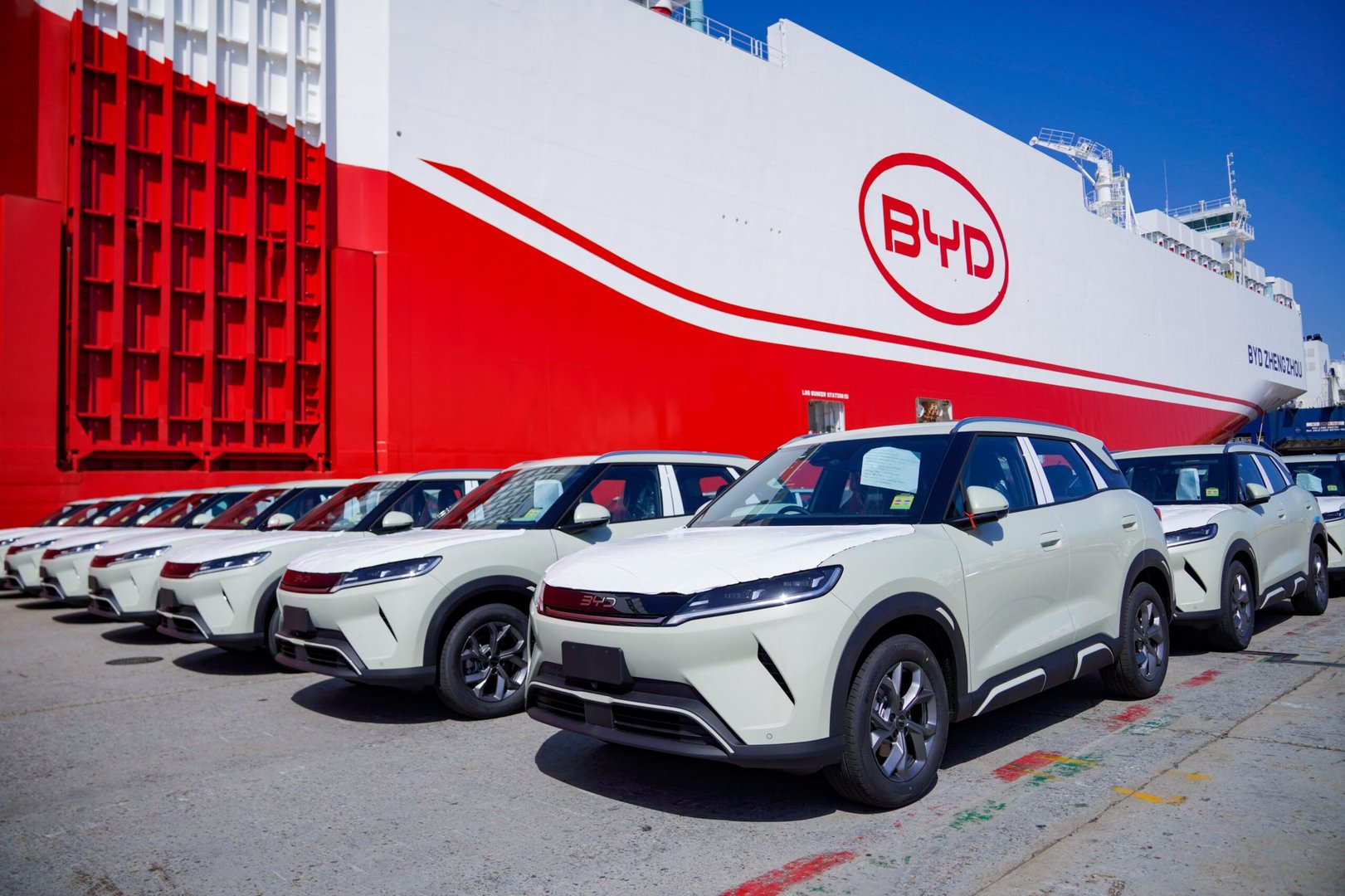
What is confirmed is that BYD has dispatched a company-operated roll-on, roll-off vessel carrying close to five thousand new energy vehicles, including battery electric and plug-in hybrid models, bound for the Australian market.
The shipment is part of a broader strategy in which the automaker increasingly relies on its own maritime logistics assets rather than depending entirely on third-party shipping capacity.
The vessel-based export approach is designed to solve a structural constraint that has emerged across the global auto industry: shipping bottlenecks.
As electric vehicle sales rise and production scales up in China, manufacturers have faced shortages of available car carriers, rising freight costs, and unpredictable delivery timelines.
Owning or controlling shipping capacity allows firms like BYD to reduce dependence on volatile spot markets for freight space.
Australia has become a key destination in this strategy due to rapidly rising demand for electric vehicles, especially in the mid-priced segment where BYD is aggressively competing.
The country’s right-hand-drive configuration also makes it a natural export market for Chinese manufacturers seeking large English-speaking economies outside Europe and North America.
The shipment includes multiple models from BYD’s growing international lineup, spanning compact electric cars, plug-in hybrids, and SUV segments.
The company has positioned these vehicles as direct competitors to both established Japanese brands and newer entrants from South Korea and Europe, particularly in price-sensitive segments where affordability is a major purchasing factor.
The key issue is that BYD’s logistics expansion is not only about meeting demand but also about controlling the end-to-end supply chain in a way traditional automakers rarely attempt.
By operating its own vessels, the company can better align production schedules with delivery timelines, reduce per-unit transport costs at scale, and avoid delays that can damage brand momentum in fast-moving EV markets.
The broader automotive industry has been moving in a similar direction, though at different speeds.
Several major manufacturers have chartered or partially invested in shipping capacity during recent global supply chain disruptions, but full vertical integration into maritime logistics remains relatively uncommon.
BYD’s approach signals a more aggressive long-term strategy that treats shipping as a core industrial capability rather than a third-party service.
Australia’s EV market is also undergoing structural change.
Incentives, fuel efficiency standards, and rising consumer interest have contributed to accelerating electric vehicle adoption, although uptake still trails leading markets in Europe and China.
Competition has intensified as global manufacturers seek to secure early market share in what is expected to be a long-term transition away from internal combustion engines.
For Australian consumers, the immediate consequence is increased availability of lower-cost electric vehicles, particularly in entry-level and mid-range categories.
For dealers, the influx of large-volume shipments can reduce delivery wait times and expand inventory diversity, but it also increases competitive pressure on legacy brands with higher price points or slower EV rollout schedules.
The long-term implications extend beyond a single shipment.
BYD’s deployment of dedicated shipping capacity suggests a structural shift in how Chinese EV manufacturers plan global expansion: not just exporting vehicles, but exporting an integrated industrial system that includes production, logistics, and distribution control.
That model is increasingly shaping competitive dynamics in global automotive markets and raising the bar for rivals attempting to match both cost and delivery speed.
The arrival of the vessel in Australia will add another large batch of electric vehicles to a market already experiencing rapid growth in EV penetration, reinforcing BYD’s position as one of the fastest-expanding players in the region and tightening competition across the mid-price electric vehicle segment.
The move reflects how fast-growing demand for electric vehicles is reshaping not only car markets, but also the shipping infrastructure that supports them.
What is confirmed is that BYD has dispatched a company-operated roll-on, roll-off vessel carrying close to five thousand new energy vehicles, including battery electric and plug-in hybrid models, bound for the Australian market.
The shipment is part of a broader strategy in which the automaker increasingly relies on its own maritime logistics assets rather than depending entirely on third-party shipping capacity.
The vessel-based export approach is designed to solve a structural constraint that has emerged across the global auto industry: shipping bottlenecks.
As electric vehicle sales rise and production scales up in China, manufacturers have faced shortages of available car carriers, rising freight costs, and unpredictable delivery timelines.
Owning or controlling shipping capacity allows firms like BYD to reduce dependence on volatile spot markets for freight space.
Australia has become a key destination in this strategy due to rapidly rising demand for electric vehicles, especially in the mid-priced segment where BYD is aggressively competing.
The country’s right-hand-drive configuration also makes it a natural export market for Chinese manufacturers seeking large English-speaking economies outside Europe and North America.
The shipment includes multiple models from BYD’s growing international lineup, spanning compact electric cars, plug-in hybrids, and SUV segments.
The company has positioned these vehicles as direct competitors to both established Japanese brands and newer entrants from South Korea and Europe, particularly in price-sensitive segments where affordability is a major purchasing factor.
The key issue is that BYD’s logistics expansion is not only about meeting demand but also about controlling the end-to-end supply chain in a way traditional automakers rarely attempt.
By operating its own vessels, the company can better align production schedules with delivery timelines, reduce per-unit transport costs at scale, and avoid delays that can damage brand momentum in fast-moving EV markets.
The broader automotive industry has been moving in a similar direction, though at different speeds.
Several major manufacturers have chartered or partially invested in shipping capacity during recent global supply chain disruptions, but full vertical integration into maritime logistics remains relatively uncommon.
BYD’s approach signals a more aggressive long-term strategy that treats shipping as a core industrial capability rather than a third-party service.
Australia’s EV market is also undergoing structural change.
Incentives, fuel efficiency standards, and rising consumer interest have contributed to accelerating electric vehicle adoption, although uptake still trails leading markets in Europe and China.
Competition has intensified as global manufacturers seek to secure early market share in what is expected to be a long-term transition away from internal combustion engines.
For Australian consumers, the immediate consequence is increased availability of lower-cost electric vehicles, particularly in entry-level and mid-range categories.
For dealers, the influx of large-volume shipments can reduce delivery wait times and expand inventory diversity, but it also increases competitive pressure on legacy brands with higher price points or slower EV rollout schedules.
The long-term implications extend beyond a single shipment.
BYD’s deployment of dedicated shipping capacity suggests a structural shift in how Chinese EV manufacturers plan global expansion: not just exporting vehicles, but exporting an integrated industrial system that includes production, logistics, and distribution control.
That model is increasingly shaping competitive dynamics in global automotive markets and raising the bar for rivals attempting to match both cost and delivery speed.
The arrival of the vessel in Australia will add another large batch of electric vehicles to a market already experiencing rapid growth in EV penetration, reinforcing BYD’s position as one of the fastest-expanding players in the region and tightening competition across the mid-price electric vehicle segment.
AI Disclaimer: An advanced artificial intelligence (AI) system generated the content of this page on its own. This innovative technology conducts extensive research from a variety of reliable sources, performs rigorous fact-checking and verification, cleans up and balances biased or manipulated content, and presents a minimal factual summary that is just enough yet essential for you to function as an informed and educated citizen. Please keep in mind, however, that this system is an evolving technology, and as a result, the article may contain accidental inaccuracies or errors. We urge you to help us improve our site by reporting any inaccuracies you find using the "Contact Us" link at the bottom of this page. Your helpful feedback helps us improve our system and deliver more precise content. When you find an article of interest here, please look for the full and extensive coverage of this topic in traditional news sources, as they are written by professional journalists that we try to support, not replace. We appreciate your understanding and assistance.